
|
||||
| ||||
Deciphering the Indus Script (book review)Deciphering the Indus Script
|


The analysis of the seals and other inscribed objects themselves can yield similar clues. For example, in chapter 7, "External Clues to the Indus Script," Parpola notes that the larger, more ornate, and more skillfully made seals tend to have longer inscriptions and special iconographic features. In such inscriptions we might expect to find prestigious titles such as "king" (p. 116), and Parpola suspects that this is to be found in the wheel-like symbol and its ligatures. In support of this tentative interpretation he offers comparative data from both the ancient Near East, describing the wheel sign as "strikingly similar to some prominent symbols of kingship in Near Eastern . . . iconography" (p. 104), and from later Indian traditions, referring to the persistent symbol of the cakravartin and his dharmacakra (p. 106).
Such analogies, based on the well-attested archaeological links between the Near East and the Indus culture, on the one hand, and on "concrete evidence suggesting that the later South Asian tradition has preserved genuine Harappan survivals" (p. 104), on the other, are exploited at length in support of Parpola's other proposed "readings" of Indus script symbols. In these readings he presents phonetic and/or logographic interpretations on the basis of reconstructed proto-Dravidian words that can be associated with the presumed iconic value of the written symbols. This approach is justified by the detailed discussion in chapters 8 and 9 of the linguistic context of the Indus culture and its writing, in which Parpola presents strong arguments for the position that the Dravidian language family is the one most likely represented by the Indus script.
This conclusion is offered, in the bold spirit that is so characteristic of this book, on the grounds that "an uncertain hypothesis is better than no hypothesis" (p. 137). As usual, the hypothesis is well grounded in hard data, including geographical and linguistic patterns based on the distribution of the Dravidian languages and related areal characteristics (see esp. p. 167), and on archaeological facts, notably the complete absence of horse-related relics in the Indus sites, which is taken to rule out an Indo-European language and culture (p. 159). These arguments in favor of the Dravidian hypothesis are, in general, already familiar to readers of recent studies of the decipherment problem, including those of Parpola himself, and reinforce what is now something like a majority consensus in its favor.
Having presented this background for his decipherment, Parpola boldly ventures in the remainder of the book (chapters 10 through 15) to posit actual Dravidian readings for specific graphemes and sequences. His starting point for this is the interpretation of the frequent "fish" symbol and its variants as a rebus sign for 'star' on the basis of the homophony of proto-Dravidian min 'fish' and min 'star' (p. 181). This too is familiar from Parpola's earlier publications, but here it is developed in greater detail and interpreted in terms of a supposed Indus valley cult of star and planet worship, supported by ethnographic observations of similar practices in classical and modern India. By way of illustrating Parpola's methods, the following is a summary of his interpretation (presented in chapter 13, "Evidence for Harappan Worship of the God Muruku") of the combination of the fish/star graph with six short vertical lines, presumably indicating the number six:
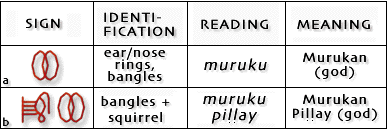
The combination of 'star' and 'six' denotes the Pleiades, and by association the Dravidian god Muruku/Murukan, who in later Indian mythology is identified with the wargod Skanda, the son of the Pleiades. It is "most likely that Murukan and Rudra-Skanda are both descended from one of the principal deities of the Proto-Dravidians, and that his name or names occur in the Indus inscriptions" (p. 226). The combination 'six-star(s)' alternates in one pair of seal inscriptions (M-112 and M-241) with the sequence 'intersecting circles-pair of vertical lines' , which therefore "may be a name of Skanda" (ibid.). The sign 'intersecting circles' can be connected to Muruku by way of a rebus reading of Proto- Dravidian *muruku 'ring', from *murV 'to twist'. This interpretation is supported by the fact that the sign 'intersecting-circles' occurs frequently in the inscriptions on Harappan bangles. Moreover, the sign 'pair of vertical lines' associated with it in M-241 can be read as an iconic representation of Proto-Dravidian veli 'enclosed or intervening space' used in rebus fashion to represent the compound name muruka- vel attested for the war-god in Old Tamil literature.
This is only a brief summary of a much more complex presentation, but it may suffice to illustrate in a general way the techniques and principles by which Parpola justifies his "readings." The arguments are invariably ingenious, well informed, and amply documented. The analytic, linguistic, and ethnographic data are woven together into an interpretative tapestry that is highly attractive, but not exactly seamless. For although each specific link is justified, the thread of associative argumentation sometimes seems too long and tangled. By way of illustration of the doubts that these interpretations arouse, I here summarize another argument (pp. 261ff.):
The inscription on the famous 'fig-tree' seal from Mohenjo-daro (M- 1186) includes a sign 'fish with a dot inside' which "is likely to represent the deity depicted on the seal" (p. 261). The deity, interpreted as a goddess of fertility and victory analogous to the later Hindu Durga, may be associated with the personified star Rohini 'the red (female)'. In later Hindu ritual, both of these deities are associated with fish. The dot sign inside the fish thus could be interpreted as representing the Dravidian word *pottu 'dot, spot, round (red) mark on the forehead' and its homophone *pottu 'kind of fish'. The red forehead dot is in modern Hindu tradition associated with Rohini, which word can also denote 'a marriageable young virgin'. The vermilion used for marking the forehead of the bride in modern Bengal is kept in a fish-shaped box. Thus, "The menstrual blood (rohita) in the womb of the sexually mature girl (rohini) corresponds to the icon of 'a dot inside a fish' in the Indus pictogram that we have supposed to signify the star Rohini"; and "The fish-shaped vermilion box with its contents, the red powder, is another instance of such a correspondence of image with the Indus sign." (p. 267)
Here it is hard to avoid the impression of over-interpretation of data that are connected only distantly at best. Granted, each association has some validity in and of itself; but when we step back and look at the whole, is it believable that the fish-shaped vermilion box used in modern Bengali weddings is in any way relevant to the interpretation of a particular graph on the Mohenjo-daro fig-tree seal? This strains credibility. Nor am I convinced, by the conclusion to this chapter, that "the Indus sign turns out to be not simply a phonetically used grapheme, but a highly condensed religious symbol, which suggests . . . that the still surviving ancient Hindu habit of making a red mark on the forehead probably goes back to the third millennium BC" (p. 272). Such a loading of multiple levels of meaning onto what is presumably a logogram and/or a phonetic rendering thereof goes against too much of what we know about early logo-syllabic writing systems (as clearly summarized by the author himself in chapter 2 of this book). If, contrary to what we might have expected from reading the earlier chapters, the Indus script turns out to work quite differently from the other most ancient scripts, in incorporating multiple levels of symbolic and visual values in addition to the normal logographic and phonetic ones, this would be most surprising - not impossible, but surprising - and such a hypothesis requires more justification on a theoretical and comparative level.
After all this, the book has something of a surprise ending. Having developed at length his provisional case for a decipherment, Parpola concludes that "it looks most unlikely that the Indus script will ever be deciphered fully, unless radically different source material becomes available" (p. 278). Yet he adds, in the last sentence of the book: "That, however, must not deter us from trying." The sentiment is quintessentially characteristic of the spirit of the book as a whole. The author is not timid about making bold hypotheses, and in some places he seems to have overshot the mark. But this is not to say that his ideas are easily disregarded. On the contrary, in some ways this is the best informed, most cogently argued, and important work to date on the Indus script. If a definitive, even if only partial, decipherment is ever achieved, it would not be at all surprising if the general outlines of the interpretations proposed by Parpola prove to be correct, even if some of the specific details will probably not. The methodological reservations expressed above notwithstanding, it may well turn out that Parpola's approach to the phonetic identification of Indus characters is in broad outline correct. In any case, this book will define the study of the Indus script for years to come, whether positively or negatively, or, more likely, both.
Richard Salomon, University of Washington
Salomon, Richard, "Deciphering the Indus Script" (book reviews). Vol. 116, The Journal of the American Oriental Society, 10-21-1996, pp. 745(3)
